When a technician walks into your flooded basement and says “this is a Category 2 loss,” that is not just restoration jargon. That single word changes almost everything that happens next: what gets dried, what gets thrown in a dumpster, what protective equipment the crew wears, how long the job takes, what it costs, and how your insurance adjuster looks at your claim.
Water damage is classified by contamination level, not by how much water is on the floor. Three categories exist under the ANSI/IICRC S500 standard, the industry document professional restorers work from. Most homeowners have never heard of it until the day they need it.
Here is what each category means, how quickly one turns into the next, what each one costs, and why the answer matters for your property and your claim.
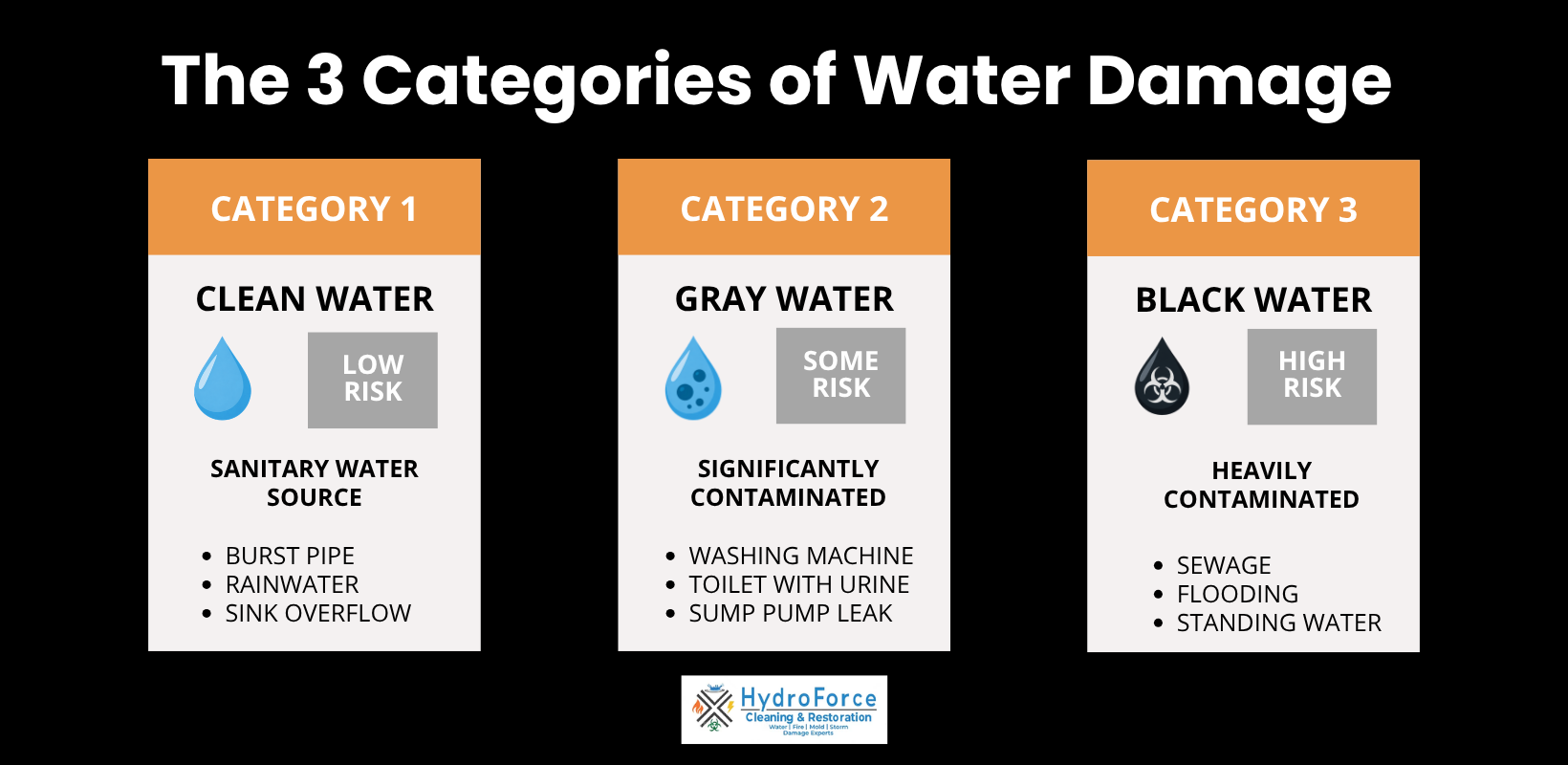
What Are the Three Categories of Water Damage?
The category tells you the contamination level of the water. It is based on where the water came from, what it has touched since, and how long it has been sitting there. A slow drip from a supply line and a basement full of that same clean water share a category, even though one is a two-hour job, and the other is a week of drying equipment.
| Category | Common Name | Contamination Level | Example Sources | Typical Salvageability |
|---|---|---|---|---|
| Category 1 | Clean water | Sanitary at the source, no substantial health threat | Broken supply lines, tub and sink overflows with no additives, broken toilet tanks, melting snow or ice, rainwater before ground contact | Most materials can be dried in place if the response is fast |
| Category 2 | Gray water | Significant chemical, biological, or physical contamination, can cause illness on contact or ingestion | Washing machine and dishwasher discharge, toilet overflow with urine but no feces, sump pump failure, hydrostatic seepage, fire sprinkler discharge, chilled water and condensate | Hard surfaces usually cleaned and saved, carpet pad and lower drywall often removed |
| Category 3 | Black water | Grossly contaminated, can contain pathogenic, toxigenic, or other harmful agents | Sewage, waste line backflows originating beyond the trap, rising river or stream water, seawater flooding, water that has picked up gross contamination indoors | Porous materials that contacted the water are almost always removed and discarded |
One note before we go further, because it comes up constantly: there is no Category 4. If someone tells you your loss is Category 4, they are either thinking of Class 4, a drying classification we cover below, or mixing up hurricane categories with water classification.
Category 1 Water Damage (Clean Water)
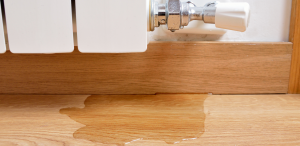
Category 1 is water from a sanitary source that does not pose a substantial threat to people at the moment it escapes. Think of a burst copper supply line, an ice maker line that lets go behind the refrigerator, a bathtub someone forgot about, or snowmelt working its way into a basement.
Common Category 1 sources:
- Broken or leaking supply lines
- Tub and sink overflows with no soap, cleaner, or other additives
- Broken toilet tanks (the tank, not the bowl)
- Appliance water line failures
- Rainwater and melting snow or ice that has not contacted the ground or contaminated surfaces
Category 1 describes the water at the source. It is not a permanent grade. Clean water stops being clean the moment it starts feeding on a building. It soaks into carpet backing, wicks up drywall, dissolves the paper facing and the organic dust inside the wall cavity, and warms to room temperature in the dark. Bacteria already present in every indoor environment do the rest.
The EPA guidance on drying water-damaged materials suggests that wet materials should be dried within 24-48 hours to prevent mold growth. Past that point, a Category 1 loss is frequently no longer a Category 1 loss.
So “clean water” does not mean “leave it and see.” It means you have the best odds of saving your flooring, your baseboards, and your drywall, and those odds shrink by the hour. A burst pipe or flooded basement caught the same day is a different project than the same failure discovered on Monday morning.
Category 2 Water Damage (Gray Water)
Category 2 water carries a meaningful degree of chemical, biological, or physical contamination. It will not necessarily make a healthy adult sick from brief skin contact, but it contains both microorganisms and the nutrients those microorganisms need to multiply. You do not want it aerosolized in your living space, and you do not want children or pets in it.
Typical Category 2 sources:
- Washing machine and dishwasher discharge
- Toilet bowl overflow containing urine but no feces
- Sump pump failure or backup
- Hydrostatic pressure seepage through foundation walls or floors
- Fire sprinkler discharge
- Condensate and chilled water lines
- Aquarium and waterbed water
What usually gets saved: hard, non-porous surfaces. Tile, sealed concrete, glass, metal, solid wood cabinetry, and structural framing can typically be cleaned, disinfected, and dried in place. Personal contents made of hard materials clean up fine.
What usually gets removed: carpet padding almost always goes. Carpet itself is a judgment call that depends on how long it sat and whether the backing delaminated. The EPA’s guidance on drying carpet and backing describes a 48-hour window, and on a gray water loss the padding underneath rarely survives it.
The bottom section of drywall often comes out, partly because gray water wicks upward inside the cavity and partly because you cannot effectively clean the back side of a wall you cannot reach. Wet fiberglass or cellulose insulation is removed rather than dried, since it loses its R-value and holds contamination.
The health note matters here. Category 2 water supports bacterial growth, and if drying stretches past that 24-to-48-hour window, you are no longer dealing with a water problem alone. You are likely dealing with a mold problem layered on top of it. That is also the reason Category 2 does not stay Category 2 indefinitely.
Category 3 Water Damage (Black Water)
Category 3 is grossly contaminated water that can contain pathogenic, toxic, or other harmful agents, and can cause significant adverse reactions in people who contact or consume it. The S500 standard names sewage, waste line backflows that originate beyond any trap regardless of what you can see in the water, all forms of seawater flooding, and rising water from rivers or streams.
In Chicago and the surrounding suburbs, the everyday version of Category 3 is a sewage backup through a floor drain during a heavy rain event. Much of the older housing stock here is served by a combined sewer system, meaning one pipe carries both sanitary flow and stormwater, and a hard rain can push that mix back up through a basement drain.
Porous materials that contact black water do not get cleaned; they get removed. Carpet, carpet pad, insulation, particleboard, unsealed wood products, and drywall come out and go in a dumpster, because contamination penetrates the material rather than sitting on the surface. There is no cleaning process that reliably decontaminates the inside of a piece of wet drywall. Attempting to save it is how people end up with a persistent odor, a recurring mold problem, or both, six months later. When a restorer tells you the bottom two feet of your finished basement must go, that is not upselling. It is the standard.
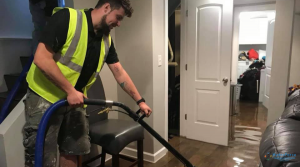
The safety side is just as real. Category 3 work requires full personal protective equipment, containment of the affected area, negative air pressure so contaminants do not migrate into clean parts of the house, HEPA filtration, and antimicrobial application after removal. Homeowners should not enter standing sewage and should not run a household box fan in it, which turns a contained contamination problem into an airborne one. If sewage has backed up into your home, the correct first move is getting people and pets out of that space and calling a certified crew.
How Water Categories Change Over Time
The S500 standard is explicit that category considers both the water’s source and its quality after it contacts materials on the job site, and that time and temperature can affect the amplification of contaminants and therefore the category itself. In plain terms: category is a moving target, and it only moves in one direction.
Three variables push it upward:
- Time: Every hour that water sits in contact with building materials, it picks up more organic material and supports more bacterial growth. Category 2 water that is not removed efficiently from a structure can be reclassified as Category 3.
- Temperature: Warm water in a warm house amplifies contamination faster than cold water in an unheated crawl space. A July basement flood in Chicago deteriorates considerably faster than the same event in February.
- Contact: What the water touches changes what is in it. Clean water that runs across a garage floor, through a crawl space, or over the contents of a storage room is not clean anymore. Water that sits on drywall paper and carpet backing has a food source.
There is also a myth worth retiring here, sometimes called the drink test: the idea that if you would not drink it, it must be Category 3. Category is not determined by how the water looks or smells. It is determined by the source, what the water has contacted, how long it has been present, and the temperature conditions it sat in.
The reclassification is not a paperwork exercise. When a loss moves from Category 1 to Category 2, materials that would have been dried get cut out instead. When it moves to Category 3, the removal scope expands, containment gets built, and the crew suits up. Cost, timeline, and disruption all climb with it.
Which is the whole reason restoration companies sound like broken records about calling immediately. It is not about booking the job. It is that the version of your loss we can respond to tonight is cheaper and less invasive than the version we would respond to on Friday.
Is Storm Water Automatically Category 3?
No. On February 10, 2026, the ANSI/IICRC S500 Consensus Body issued a position statement addressing this directly: top-down water ingress, wind-driven rain, and water from weather-related events are not automatically considered Category 3.
The confusion comes from the S500 definition itself, which says examples of Category 3 water can include contaminated water entering the indoor environment, such as wind-driven rain from hurricanes, tropical storms, or other weather-related events. Many people read that as a rule. The Consensus Body clarified that “can” is a defined term in the standard, signifying a possibility open to the user of the document rather than a component of the accepted standard of care. The operative words in that example are contaminated water, not wind-driven rain.
In plain terms: how the water got in does not set the category. Whether it is grossly contaminated does. Rain that comes through a storm-damaged roof and lands on your ceiling may well be Category 1 or 2.
This matters for your wallet. A loss classified Category 3 by assumption instead of by inspection carries removal and disposal of porous materials, containment, PPE, and antimicrobial treatment that a Category 1 or 2 loss of the same footprint does not. The position statement requires a determination based on inspection and information gathering, not on how the weather looked outside.
What Each Category Costs to Clean Up
Contamination level is the primary cost driver, ahead of square footage. A Category 3 loss carries removal and disposal of porous materials, containment, PPE, antimicrobial treatment, and a larger rebuild afterward. A Category 1 loss of the same footprint may be extraction, drying, and a paint touch-up.
| Water Type | Relative Cost Per Square Foot | What Drives the Number |
|---|---|---|
| Category 1, clean water | Lowest | Affected area, drying class, whether materials can stay in place |
| Category 2, gray water | Mid | Added cleaning and disinfection labor, carpet pad and lower drywall removal |
| Category 3, black water | Highest | Full PPE, containment, extensive disposal, decontamination, larger rebuild scope |
Does the Water Damage Category Affect Your Insurance Claim?
The short answer is yes, the category affects your claim, though usually not in the way homeowners expect.
Your policy does not contain a clause that says “Category 2 losses are covered, and Category 3 losses are not.” Coverage turns on the cause of loss and your policy language. But the category shapes the claim in several concrete ways, which is why adjusters ask about it early.
Category Drives the Scope, and Scope Drives the Dollars
A Category 3 loss requires removal and disposal of porous materials, containment, PPE, antimicrobial treatment, and a larger rebuild. A Category 1 loss of the same square footage may be extraction, drying, and paint. Same footprint, very different estimate. When an adjuster reviews a scope that includes flood cuts and material disposal, the category is the justification for it.
Category Interacts with the Sudden-Versus-Gradual Distinction
Most standard homeowners policies cover water damage that is sudden and accidental, such as a burst pipe or a failed water heater. Damage from long-term seepage, deferred maintenance, or a leak that was left alone is commonly excluded.
Here is the trap. A slow leak that finally shows itself has usually been degrading for weeks, which means it presents as contaminated water with existing microbial growth. That contamination is evidence of duration, and duration is exactly what an insurer uses to argue gradual damage. Sudden failures caught fast tend to present as clean water. The category, in effect, tells a timeline story, and it tells that story to someone whose job includes looking for reasons a loss was not sudden.
Flood and Sewer Backups Are Separate Conversations
Rising surface water and sewer backup are generally not covered under a standard homeowners policy. Rising water is Category 3 by definition, and sewer or drain backup coverage is typically an endorsement you either purchased or did not.
What This Means for Chicago and Cook County Homeowners
Sewer and drain backup coverage is an endorsement, not part of a standard policy, and it usually carries its own dollar limit that is far lower than your dwelling coverage. In older Chicago neighborhoods and inner-ring suburbs served by combined sewers, a heavy rain event can push water back through a floor drain, and that is Category 3 by definition.
If you have a basement with a history of backups and you have never specifically asked your agent about a backup endorsement and its limit, assume you do not have one. Many Chicago-area homeowners with backup history carry it. Many others assume they have it because they have “water damage coverage,” which is a different thing.
If your carrier delays or denies a claim you believe is covered, the Illinois Department of Insurance accepts written consumer complaints against insurers and assigns each one a file number.
Documentation is the Whole Game
The category is established by the restorer’s preliminary determination, which under the S500 is supposed to be based on inspection and information gathering rather than a guess. That determination needs to be written down, along with photos taken before anything is removed, moisture readings, the identified source, the date and time the intrusion started, and an itemized list of what came out and why. Claims get reduced or denied far more often for thin documentation than for the wrong category.
Take your own photos before any cleanup begins, even if a crew is already on the way.
We are a restoration company, not insurance advisors, and none of the above is a coverage opinion on your specific policy. Read your declarations page and call your carrier or agent to confirm what applies to your situation. What we can do is document the loss thoroughly, classify it correctly, and communicate directly with your adjuster so the scope we submit is defensible.
Water Damage Categories vs. Classes (The Difference Most People Miss)
Two separate classification systems exist under the S500, and they get conflated constantly, including by people who should know better.
Category (1 through 3) describes contamination. It answers: how safe is this water, what PPE is required, what gets cleaned versus discarded, and can people be in the space.
Class (1 through 4) describes the drying problem. It answers: how much water is in the structure, how fast will it evaporate, how much equipment does this need, and how long will it take.
| Class | What it means | Rough identifier |
|---|---|---|
| Class 1 | Least water, minimal absorption | Small affected area, low-absorption materials |
| Class 2 | An entire room, moderate absorption | Wicking up walls, typically under 24 inches |
| Class 3 | Greatest volume, fastest evaporation load | Water from overhead, saturated ceilings, walls, and insulation |
| Class 4 | Specialty drying, low-permeance materials | Hardwood, plaster, brick, concrete, stone that release moisture slowly |
Any category can pair with any class. That is the part people miss, and it explains most of the confusion homeowners have about why a “clean water” job turned into demolition.
This is also the answer to a question we get all the time: why does a clean water loss sometimes require cutting drywall?
Because clean water can still saturate the inside of a wall cavity, and the only way to dry a cavity effectively is to open it. A flood cut is a horizontal cut in the lower section of drywall, usually 12 to 24 inches above the floor, that lets us remove wet material, get airflow behind the wall, and see what we are drying. The water being sanitary does not make the structure dry.
A large share of the housing stock in Chicago and the inner suburbs is Class 4 territory. Plaster over lath, brick, and slab-on-grade concrete hold moisture deep inside and release it slowly, which is why a loss in a 1920s bungalow takes longer to dry than the same loss in new construction.
How Professionals Determine and Handle Each Category
The determination is not made by looking at the water. Under the S500, the restorer performs an inspection and information gathering process, then arrives at a preliminary determination that sets the scope of work. That process includes verifying the source, establishing when the intrusion started, identifying how far the water migrated, and noting suspected contaminants and any pre-existing damage.
In practice, that means:
- Moisture mapping: Penetrating and non-penetrating meters, thermal imaging, and hygrometer readings to find how far and how deep the water traveled. Visible wet flooring is rarely the full extent. Water follows framing and gravity into places you cannot see, and drying decisions depend on knowing where it went.
- Source and timeline verification: Two identical wet basements with different start times are two different categories and two different scopes.
- Contamination assessment: For elevated-risk situations, such as high-risk occupants, public health settings, or a need to confirm whether contamination is present, an indoor environmental professional may be brought in to sample and interpret lab results rather than relying on visual assessment alone.
- Containment for Category 2 and 3: Physical barriers, negative air pressure, HEPA air scrubbers, and worker protection are established before drying begins rather than after. Remediation comes first, then restorative drying.
- Documented dry standards: A drying goal set against unaffected materials in the same building, with daily readings until the structure hits it, so nothing gets closed up wet.
Our IICRC-certified technicians handle this on every loss, from a Category 1 supply line break to a Category 3 sewage backup. We serve Chicago, Bridgeview, Burbank, and Cicero, along with the surrounding south and southwest suburbs.
What to Do Right Now If You Have Water Damage
If water is in your home as you read this, work through these in order.
- Stop the source if you can safely reach a shutoff valve. Know where your main is before you need it.
- Kill the power to affected areas at the breaker if water is anywhere near outlets, cords, or the panel. If you cannot reach the panel safely, stay out and call an electrician or the utility.
- Get people and pets out of any space with sewage, drain backup, or unidentified standing water. Do not wade in to assess it.
- Photograph everything before you move or remove a single item. Take wide shots of each room, close-ups of the source, and video walking the affected area. Note the time you discovered it.
- Do not run household fans on anything other than clean water. On Category 2 or 3 losses, a box fan spreads contamination through your air.
- Move what you can save. Lift furniture off wet carpet, get documents and electronics out of the area, and pull up rugs if they are light enough to handle.
- Call a certified restoration company immediately, not after the weekend. The category is climbing while you wait.
- Call your insurance carrier to open a claim and get a claim number.
If your basement took on water during a widespread storm event rather than an isolated failure, the Metropolitan Water Reclamation District publishes a Cook County flood response resource guide covering reporting, cleanup, and available assistance.
Water Damage in Chicago and Cook County
HydroForce Cleaning & Restoration has been handling water losses across Chicago and Cook County since 2011. We are IICRC-certified, on-site in 60 minutes or less, available 24/7 including holidays, and we bill your insurance directly. Every project gets a dedicated Project Manager who documents the loss and stays in contact with your adjuster from the first day.
Call (630) 835-0862 now to learn more about our 24/7 water damage restoration in Chicago, IL, and get a free, no-obligation estimate.
Water Damage Category FAQs
What are the three categories of water damage?
Category 1 is clean, sanitary water from sources like broken supply lines and tub overflows. Category 2, or gray water, carries significant contamination that can cause illness, from sources like washing machine discharge and sump pump failures. Category 3, or black water, is grossly contaminated and may contain harmful agents, from sources like sewage, waste line backflows beyond the trap, and rising river water. The categories are defined by the ANSI/IICRC S500 standard.
What is the difference between clean water, gray water, and black water?
They are the common names for Categories 1, 2, and 3. Clean water poses no substantial health threat at its source. Gray water contains chemical, biological, or physical contamination that can cause illness on contact. Black water is grossly contaminated and can carry pathogenic or toxigenic agents. The distinction determines what protective equipment is required, what materials can be saved, and whether containment is needed.
Can Category 1 water turn into Category 2 or 3?
Yes, and it commonly does. The S500 standard notes that category depends on the water’s source and its quality after contacting materials on site, and that time and temperature affect contaminant amplification. Clean water sitting on drywall and carpet in a warm house picks up organic material and supports bacterial growth. Category 2 water that is not removed efficiently can be reclassified as Category 3. This is why the 24-to-48-hour window matters.
Does the water category affect my insurance claim?
Indirectly, and significantly. Your policy covers based on the cause of loss rather than the category, but the category drives the scope of work, which drives the cost of the claim. Contamination can also suggest that a leak was present for a long time, which insurers use when distinguishing sudden and accidental damage from gradual damage that is often excluded. Rising floodwater and sewer backup generally require separate coverage. Confirm your specific coverage with your carrier or agent.
Is there a Category 4 water damage?
No. The IICRC S500 recognizes only Categories 1 through 3. People saying “Category 4” usually mean Class 4, which describes specialty drying for dense materials like hardwood, plaster, brick, and concrete. Others are confusing hurricane categories with water damage classification. If a contractor tells you your loss is Category 4, ask them to clarify.
What is the difference between a water damage category and a water damage class?
Category (1 to 3) describes how contaminated the water is and drives safety and cleaning decisions. Class (1 to 4) describes how much water is in the structure and how difficult drying will be, which drives equipment and timeline. Any category can pair with any class, so a clean water loss can still be a large, expensive drying project.
Is storm damage automatically Category 3 water?
No. A February 2026 position statement from the ANSI/IICRC S500 Consensus Body clarified that top-down water ingress, wind-driven rain, and water from weather-related events are not automatically Category 3. The determination depends on whether the water is grossly contaminated, which requires inspection rather than assumption.
Can I clean up Category 3 water myself?
No. Category 3 water can contain pathogenic and toxigenic agents, and cleanup requires full personal protective equipment, containment, negative air pressure, HEPA filtration, and proper disposal of contaminated porous materials. Running a household fan in it spreads contamination through your air. Keep people and pets out of the space and call a certified restoration company.